


Why Anti-Captcha Beats Google's New reCAPTCHA Hand Gesture Verification (and AI Solvers Can't)
Google has rolled out a new kind of reCAPTCHA challenge: hand gesture verification. Instead of clicking blurry traffic lights or checking a box, the visitor is asked to turn on their camera and perform a physical gesture with their hand — for example holding up a certain number of fingers, making a specific shape, or following an on-screen prompt in real time. This is a major shift away from static image puzzles toward live, behavioral, "prove you are a real human in front of a real camera" verification.
In this article we explain how the challenge works, why purely automated AI captcha-solving services struggle with it, and why Anti-Captcha — a service backed by real human workers — is uniquely positioned to handle it.
What is the reCAPTCHA hand gesture challenge?
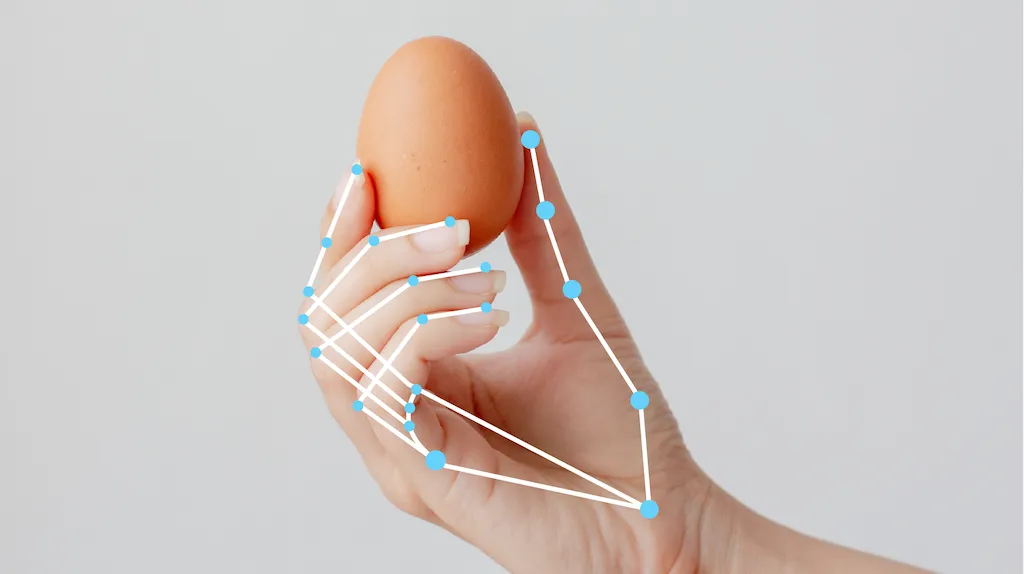
According to Google's own documentation, the challenge works by asking the user to grant camera permission and then perform hand actions on camera. Google's system does not store the raw video; instead it extracts 21 hand-knuckle coordinates (a skeletal "wireframe" of the hand) from the camera feed and uses that landmark data to decide whether a genuine, living human is performing the requested motion. Per Google, the footage is never tied to a user identity and is deleted after the verification completes, and audio is never recorded. For users who cannot perform gestures, reCAPTCHA keeps offering the traditional visual and audio challenges.
Technically, the gesture recognition is built on the same family of technology as Google's MediaPipe Hand Landmarker, which detects 21 precise hand-knuckle points per hand, distinguishes left from right, and tracks the hand across video frames in real time. The verification therefore is not a single snapshot — it is a continuous stream of motion that has to look biomechanically and temporally like a real hand moving in real space.
Why this is so hard to defeat
Classic captchas test recognition: can you read this text, can you find the bicycles. Those are one-shot, static problems that modern computer vision eventually catches up with. Hand gesture verification tests something fundamentally different — liveness and embodiment. It asks: is there a physical, three-dimensional human hand in front of a real camera, reacting on demand, with the natural micro-movements, lighting response, depth, and timing of a living person?
That changes the game entirely. The challenge combines several signals at once:
- Real-time interaction — the gesture must be produced on demand, in response to a prompt, within a time window. There is no static asset to pre-analyze.
- 3D liveness — a real hand has depth, parallax, skin texture, shadows and natural tremor that a flat image or a looped clip does not.
- Temporal consistency — the motion has to be continuous and physically plausible frame to frame, matching the 21-point hand skeleton over time.
- Hardware signals — camera metadata, frame rate, sensor noise and environment all feed into the "is this a genuine capture?" decision.
Why AI-based captcha solvers fail here
AI-only captcha-solving services are excellent at recognizing pixels. They are not built to physically exist in front of a camera. The hand gesture challenge attacks exactly the gap that automated solvers cannot close:
- There is nothing to "recognize." An AI solver receives an image and returns an answer. Here, there is no image to send — the system demands a live camera stream of a moving hand. The solver would have to generate a convincing real-time human hand, not classify a picture.
- Synthetic hands get caught. To fool the challenge with AI, you would need to deepfake a photorealistic 3D hand in real time and feed it through a virtual camera. Liveness detection is specifically engineered to flag exactly this: virtual cameras, replayed clips, and rendered hands lack the depth cues, sensor noise and natural variability of a real capture, and they rarely survive a fresh, randomly-prompted gesture.
- Prompts are dynamic. Because the requested gesture and timing vary, a pre-rendered or cached response does not work. The "solver" has to improvise a brand-new, physically correct motion every time — trivial for a human, extremely hard to fake convincingly at scale.
- The accuracy bar keeps rising. Every time a generative model gets good enough to fake a gesture, Google can adjust detection thresholds and add new behavioral signals. Static AI recognition is always one step behind a liveness target that is designed to move.
Why Anti-Captcha is the right answer
Anti-Captcha is not an AI service. At its core is a global network of real human workers. When a challenge fundamentally requires a real person — a real hand, a real camera, a real reaction — the most robust and future-proof way to pass it is to have an actual human do exactly what the challenge asks. That is precisely what Anti-Captcha provides.
- Genuine human liveness. A living worker with a real camera produces the depth, motion and natural variability that liveness detection is looking for — not a render that has to "beat" a detector.
- Adapts to any new gesture instantly. Humans understand and perform new prompts without retraining a model. When Google changes the gesture set or the flow, our workers simply follow the new instructions — no model update required.
- Resilient to detection upgrades. Because the work is done by a real person, tightening anti-spoofing thresholds does not break the approach the way it breaks synthetic/AI attempts. Real humans are the one input a "prove you are human" test is designed to accept.
- Same simple API you already use. Anti-Captcha exposes one consistent JSON API (createTask → getTaskResult) across every captcha type. As support for new interactive challenges is added, you integrate it the same way you integrate reCAPTCHA, Turnstile or image captchas today.
- Speed and scale. A large, always-on worker pool means challenges are handled quickly and around the clock, with reporting endpoints to flag and refund failed attempts.
The bottom line
Google's hand gesture verification is deliberately built to stop automation by demanding something only a real human in front of a real camera can naturally provide. That is exactly why AI-only solvers hit a wall — and exactly why a human-powered service like Anti-Captcha is the natural fit. As the captcha industry shifts from "recognize this image" to "prove you are a living human," the advantage moves decisively to services that have real people at their core.
Want to integrate Anti-Captcha's reCaptcha solving into your application? Start with the API documentation and an account creation.